

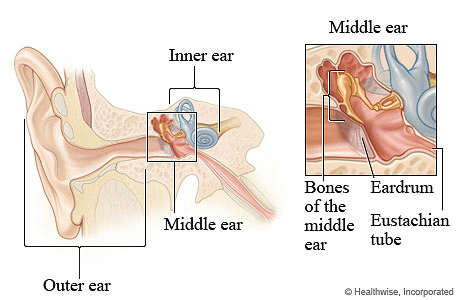
How hearing works
Sound vibrations travel through the ear canal down to the eardrum. These vibrations move through the ear drum, which is connected to the tiny bones of the middle ear, and then to the cochlea in the inner ear. Inside the cochlea, thousands of delicate hearing receptors called hair cells convert the vibrations into electrical signals which are sent to the brain for interpretation. There are three parts to hearing: detecting sound, interpreting sounds and attaching meaning to them. Any disruption along this pathway can lead to hearing loss or difficulties hearing in background noise. See also how we hear.
Types of hearing loss
Conductive hearing loss
Conductive hearing loss occurs when sound cannot efficiently pass through the outer or middle ear. Sounds may seem quieter or slightly muffled, though clarity can often be restored by increasing volume. Essentially, a mechanical barrier is preventing sound vibrations from reaching the inner ear.
Common causes:
- Earwax blockage (cerumen impaction)
- Middle ear infections (otitis media)
- Fluid behind the eardrum
- Eardrum perforation
- Problems with the ossicles (middle ear bones), such as otosclerosis
- Narrowing or malformation of the ear canal
Conductive hearing loss may be temporary or treatable through medical or surgical intervention. In some cases, hearing aids or bone conduction solutions are recommended. It is best to speak with an audiologist for a comprehensive diagnostic hearing assessment to investigate further.
Sensorineural hearing loss
Sensorineural hearing loss results from damage to the inner ear (cochlea) or the auditory nerve. This type of hearing loss reduces both volume and clarity and commonly affects the ability to hear speech in noisy environments.
Common causes:
- Age-related hearing loss (presbycusis)
- Noise exposure (workplace, concerts, machinery, headphones)
- Genetic factors
- Ototoxic medications (medicines that can damage hearing)
- Viral or bacterial infections affecting the inner ear
- Head trauma or neurological conditions
Sensorineural hearing loss is generally permanent. Treatment focuses on improving communication through:
- Hearing aids
- Cochlear implants
- Assistive listening devices
- Aural rehabilitation and communication strategies
Mixed hearing loss
Mixed hearing loss is a combination of conductive and sensorineural loss. For example, a person may have age-related inner ear changes alongside a middle ear infection.
Treatment often involves addressing the conductive component first (for example medication, removal of wax, or surgery), followed by amplification solutions such as hearing aids if required.
Common risk factors
- Long-term noise exposure
- Family history of hearing loss
- Increasing age
- Chronic health conditions (for example diabetes, cardiovascular disease)
- Frequent ear infections in childhood or adulthood
- Use of ototoxic medications
When to seek a hearing evaluation
You may benefit from a hearing assessment if you:
- Frequently ask others to repeat themselves
- Feel others are mumbling
- Have difficulty hearing speech in noisy environments
- Turn the TV or radio up louder than others prefer
- Experience ringing, buzzing or humming in your ears (tinnitus)
Early diagnosis leads to better outcomes, both for hearing ability and long-term brain health. Remember: a stimulated ear supports a stimulated brain.
At Victorian Hearing, we provide:
- Comprehensive diagnostic hearing assessments
- Clear and personalised explanations of your hearing results
- Evidence-based treatment recommendations
- Long-term support to help you live life with confidence
Middle ear pathologies
A functioning middle ear system is essential to the efficiency of the general hearing process. The middle ear consists of the tympanic membrane (eardrum) and an air-filled chamber containing a chain of three bones (ossicles). The middle ear acts as an amplifier of sound, whereas the inner ear (cochlea) acts as a transducer, changing mechanical sound waves into an electrical signal that is then sent to the brain via the auditory nerve.
Symptoms of a middle ear pathology
- A blocked sensation in one or both ears
- Discharge of fluid from the ear canals
- Pain in one or both ears
- Tinnitus
- A high temperature or fever
Types of middle ear pathologies
- Otitis media: the medical term for an ear infection or middle ear inflammation. It can occur in one or both ears and generally affects children more often than adults. People generally report a feeling of fullness or "blocked" ears. The symptoms can either be silent (you're not aware of any problem) or acute (pain and obvious signs that there is a problem).
- Otosclerosis: an abnormal growth of bone in the middle ear.
- Cholesteatoma: a destructive and expanding growth of skin cells on the eardrum or the mastoid process.
- Ossicular chain dislocation: a dislocation of part of the chain of the three tiny bones in the middle ear space.
- Direct trauma: trauma to the ear canal or middle ear through an object being physically inserted into the ear canal.
- Temporal bone trauma: may be a fracture to a part of the skull causing conductive hearing loss.
- Congenital malformation of the ossicles: this can be an isolated phenomenon or can occur as part of a syndrome involving development of the 1st and 2nd branchial arches, such as Goldenhar syndrome, Treacher Collins syndrome and branchio-oto-renal syndrome.
- Superior canal dehiscence: caused by a thinning or complete absence of the part of the temporal bone overlying the superior semicircular canal of the vestibular system. There are numerous cases of symptoms developing after physical trauma to the head.
Diagnosis and treatment
Diagnosis of middle ear pathologies is usually done by an ear, nose and throat specialist (ENT), a general practitioner or an audiologist. In most instances, you will be required to undertake a hearing assessment to assess the level of hearing loss (if any), and tympanometry, which is an objective measurement of ear drum mobility, middle ear pressure and middle ear volume. This provides very useful information in differentially diagnosing the specific type of middle ear pathology.
You can contact your GP, an audiologist, an ENT specialist, or Victorian Hearing on (03) 9558 8842.
Most middle ear pathologies are treatable, with the associated hearing loss (if any) recoverable back to pre-hearing loss levels, however this is not the case for all middle ear afflictions. You will need to consult your ENT or GP about the most suitable course of treatment for your specific middle ear issue.
Mild cases of otitis media may be treatable with paracetamol, however you should always seek advice from your GP before beginning this course of action. More severe cases may necessitate antibiotic treatment or surgery to insert pressure-releasing tubes into the eardrum.
Other middle ear pathologies such as otosclerosis, cholesteatoma or ossicular chain dislocation may require more in-depth surgery to prevent further deterioration of hearing. Not all middle ear pathologies require medical intervention, and the fitting of hearing aids may be recommended on the advice of an ENT.
Ototoxicity
Ototoxicity is poisoning of the ear (oto = ear; toxicity = poisoning). It is a result of exposure to chemicals or drugs that damage the inner ear (cochlea) or the vestibulocochlear nerve (the nerve that sends hearing and balance information to the brain). It usually occurs as a side effect of a drug, and ototoxic damage causing hearing loss is generally irreversible.
Which drugs can cause ototoxicity?
Several drugs can cause ototoxicity. Usually they are prescribed, despite the possibility of damaging a patient's hearing, for very serious health conditions. These drugs include antibiotics such as gentamicin, loop diuretics such as furosemide and platinum-based chemotherapy agents such as cisplatin. A number of nonsteroidal anti-inflammatory drugs (NSAIDs) have also been shown to be ototoxic.
Signs and symptoms
Ototoxicity typically occurs when the inner ear is poisoned by medication which damages the cochlea, the vestibule, the semicircular canals or the auditory nerve. As a result, a patient may experience hearing loss, disequilibrium or vertigo, and tinnitus.
A patient may also experience:
- A higher risk of falls due to balance issues
- Cognitive effects, as hearing loss has been linked to cognitive decline and risk of dementia
- Psychological effects, such as depression, isolation, anxiety, anger and self-esteem issues
- Broader economic impacts, such as a higher rate of unemployment and difficulty gaining employment and advancing a career
Treatment
No specific medical treatment is generally available. However, withdrawal of the ototoxic medication may be advised when the risks of doing so are less severe than the hearing loss or associated symptoms caused by ototoxicity (meaning if the person is healthy enough to be taken off the medication, they will be).
Hearing aids may be a successful option in treating a hearing loss caused by ototoxicity, and it is worth consulting an audiologist about the best form of treatment.